

SPEAKING BACK
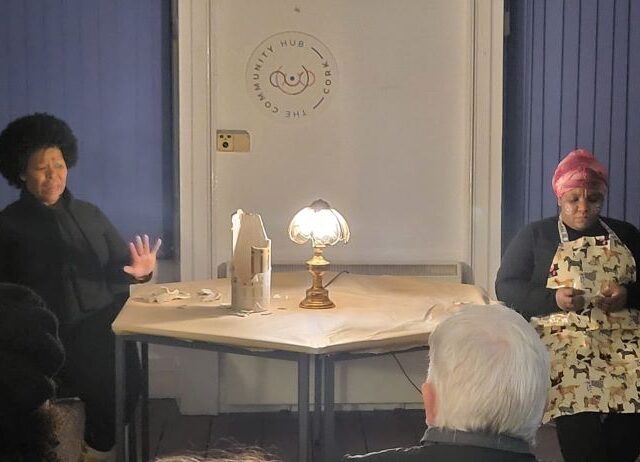
Speaking Back Performance piece. Performed by Gloria Zulu and Neo Gilson. Image by Eve Olney
Eve Olney and women affected by domestic and gender-based violence
Funded by the Arts Council Artist in the Community Scheme
The socially engaged arts project, SPEAKING BACK, was realised through an Artist in the Community Scheme Project Realisation award in 2023 and completed in 2024. Artist and organiser, Eve Olney, worked with a small group of women who were interested in collectively exploring their experiences as survivors of domestic and gender violence, through a self-organised, self-reflective mode of practice. The project resulted in a multi-media public art exhibition/event at Cork Sexual Violence Centre, hosted by Mary Crilly and Dola Twomey. The exhibition consisted of works of art individually created by each woman, in collaboration with Eve, including a live theatre performance during the event.
Participants
The three participants who worked with Eve, met at a Balaclava Crochet Group that was run through the Living Commons community creative space initiative, on Shandon Street, Cork. As the people who came to the group became more familiar with each other they began sharing stories and experiences of their lives. Conversationally, there existed a common theme of gender and domestic violence – both in terms of personal experience and research/activism. Realising there needed to be boundaries and structure in terms of speaking openly about these matters in explicit details, Eve suggested creating a more nuanced and solidarity of care-led approach in exploring these experiences. The group discussed the need for it to be directed by a more mindful, self-reflective and self-directed process and agreed to work with Eve in applying for the Artist in Community Scheme award as a means of exploring this theme through the critical structure of an arts project.
Aims
The main discussions within the group were directed towards self-organisational strategies, ‘fighting back’ and how to make domestic and gender violence a community issue. As each of the women was from a different country and culture they became more aware of a global failure to address this issue adequately. There was also a strong sense of cynicism within the group towards the limitations of the services that exist to support survivors like themselves as well as the patriarchal tendencies of the legal supports that caused the women additional harm and social disadvantage. In their own words they outlined their main aims and objectives:
‘Through sharing our stories we realised 1) that we were not alone in our experiences 2) our experiences are cross-cultural and universal 3) we are entitled to speak out against ongoing oppression 4) currently there is no way of speaking back to an oppressive legal system. Working with Eve we discussed how – due to the serious nature of the experiences we share –we need a more care-centred, structured and strategic mode of self-organizing in order to move the group towards creating something productive and empowering that can help others like us and lead to change.’
Methods
The group participated in months of preparatory reflective work before beginning the project. One of the main concerns was not having a professional present trained in psychological/embodied trauma. In considering how Eve and the participants might create a space that could carry this kind of thematic without causing harm to anyone, they agreed upon the Ulex Project’s programme of ‘Brave Space’, as a workshop strategy. It was understood that the project was very different to an art therapy approach and the intention was to make these characteristics clear. Brave Space is conceived through a self-organisational, self-knowing, mindful and reflective process that enables groups to address the complexity and discomfort of working with difference and sensitive themes. Should the potential of harm arise, there is an agreed process of ‘stepping out’ of the activity and creating a space of reflection and discussion as to how to approach it differently. This proved a very useful tool during the course of the project. For example, a method of one person speaking their story as others took notes was changed for one of the participants, to themselves writing their own story on post-its, in silence, and then the rest of the group working with the post-its.
Other methods and workshop strategies included an ongoing, progressive and reflective process as well as a workshop on, How to collaborate? The latter enables individual and collective reflection on expectations, assumptions and motivations for working on the project; how different tendencies and approaches might clash; and how people would work through these potential conflicts as a collective.
Eve worked with each community member in creative processes that they were familiar with – such as junk journaling, soap making, writing, embroidery, painting – whilst discussing how characteristics of the processes interconnect in different ways with how they might speak back against the oppression they felt as a result of their experiences.
Artistic Outputs
Each of the women were extremely creative but had never put themselves forward professionally or identified as artists due to their individual life experiences.
Due to the pressures and realities of their lives the women became more distant from each other as the project continued. Eve worked with each individually in realising an artwork that represented how each of the women chose to ‘speak back’.
Artwork 1: I Can’t Believe I’m Still Fucking Alive
A half-stripped chair, half-upholstered using bed sheets with embroidered quotations from different professionals who were meant to professionally support one of the women.
Artwork 2: Speaking Back
A performance, written and performed by (Gloria) Nomalanga Zulu (also performed by Neo Gilson), draws from a lifetime of struggle against gender violence both systemic and domestic. It maps the trail of misogynistic societal / cultural violence from childhood in South Africa to current living conditions in Cork city.
Artwork 3: You’re Not Crazy…Just Breathe
A multi-media artwork by Susan Barimo described as a ‘tapestry of resilience’. Susan sculpted her own hands from soap and created a water system around it where the water just misses the hands and therefore dissolving the sculpture. A poem accompanies the installation.
-
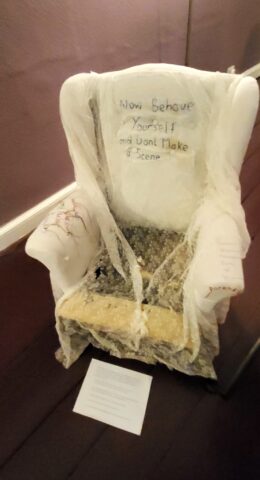
- I Can’t Believe I’m Still Fucking Alive Mixed Media artwork by group participant and E Olney; additional embroidery by SJ Booth. Image by Eve Olney
-
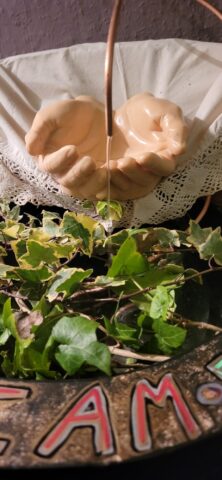

- You’re Not Crazy…Just Breathe. Mixed Media artwork by Susan Barimo. Image by Eve Olney
-
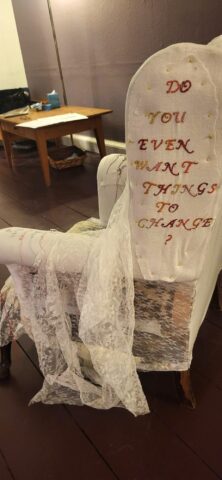
- I Can’t Believe I’m Still Fucking Alive Mixed Media artwork by group participant and E Olney; additional embroidery by SJ Booth. Image by Eve Olney
Evaluation Methodology
Each of the women found the process and the outputs of the work empowering in different ways. It encouraged one woman to begin identifying as a professional artist; she has since received arts funding. It encouraged another of the women to develop her work through a creative arts qualification. The woman who co-created the embroidered chair, said she found the experience cathartic and empowering and heard that her work had inspired another survivor of gender violence to explore some of the themes present in the work.
Outcomes
The three works were presented at an exhibition / event at the Cork Sexual Violence Centre, entitled, SPEAKING BACK, hosted by Mary Crilly and Dola Twomey, as part of the 16 Days of Activism against Gender-Based Violence, 2024. There was a reception and a discussion with the audience after the Speaking Back theatre performance.