Tales My Granny Told Me

Tales My Granny Told Me display at Athlone library. Photo: Esther Moliné
Keith Payne and New Horizon refugee & asylum seeker support with International Protection applicants from Lissywollen Direct Provision Centre, Athlone
Funded by the Arts Council Artist in the Community Scheme, managed by Create, the National Development Agency for Collaborative Arts.
There is a power in spoken word, my grandmother knew that.
– Ifeoma, Nigeria.
TALES MY GRANNY TOLD ME collected stories from around the world brought to Ireland by International Protection Applicants. Stories, and song, were collected on-site at the Lissywollen Direct Provision Centre, Athlone and were recorded and broadcast over the summer of 2022 on Athlone Community Radio. A selection was collected and published in Tales my Granny Told me, launched by then Chair of the Arts Council Prof. Kevin Rafter at The Aidan Heavey Library, Athlone. Tales my Granny Told me is a local project with a national impact. The unique book and accompanying podcast will be added to the National Folklore Collection, housed in UCD.
Participants
A funeral at a Direct Provision Centre accompanied by an impromptu song and storytelling session, with members of the community lamenting the loss of their stories and songs, led to Tales my Granny Told me.
Residents of the Direct Provision Centre in Lissywollen contacted artist Keith Payne via Gerry Callaghan of New Horizon Refugee and Asylum Seeker Support, asking for the lore they had carried across thousands of miles, to be recorded, shared and celebrated with the larger community. They began talking about the kind of stories they wanted to tell, how they would like to be represented, and how they would like to share their stories in book form with the wider community. ‘Story is essential to who we are. We are enthusiastic about becoming Irish citizens and making our home here, and part of that excitement is bringing our stories with us and sharing them with the community.’ In all, participants were from nine different countries ––notably 79% female–– speaking eleven distinct languages. Stories were told initially in the native language and then in English.
Aims
The goal was to celebrate the diversity and cultural breadth of the New Irish Community, conveying the inherent truth that there is more that unites us than separates us. It was important for the participants to see their lives reflected in Irish Art, to celebrate a renewal of Irish identity and an engagement with the arts as a valued feature of their lives.
At the hearth of Tales my Granny Told me is the knowledge that story is essential to who we are and that a community with a voice is a community that exists. As a community-based project TMGTM
- Responds to calls from the New Irish Community on the loss of their lore, folktales, lullabies, stories and songs as they become separated from their source.
- Records, broadcasts, publishes and archives these stories ensuring their longevity here in their new homeplace.
- Represents the New Irish Community in stories as selected by themselves corresponding to how they wish to see themselves reflected in Irish art.
- Reveals to the existing community the wealth of lore, story, song and culture on their doorsteps, an enrichment of the lives of individuals and the entire community.
- Strengthens the ties between the new and the existing community by showing how much we each have in common.
- Brings the wealth of culture now living in Ireland into the classroom, and thus into the lives of students as part of a TGMTM Schools’ Programme.
- Evaluates comprehensively the entire process by an evaluation professional and ex-Direct Provision resident.
- Treats the tellers as artists with appropriate pay for each telling thus emphasising the professional value of their cultural work.
- Uses local media: news, radio, public institution networks. As evidenced in numerous cases, the use of local media is far more efficient and productive for such a project.
TMGTM shows how the New Irish Community are eager to form part of and engage fully and productively with the community they now belong to, and to help shape the new audience for Irish Art of which they are a part. With almost 50 Direct Provision centres nationwide, Tales My Granny Told Me is a project that can be replicated throughout the country, enhancing diversity in Irish Art and responding acutely and creatively to the rise in anti-migrant discourse and resultant violent actions against our community.
Methods
After the initial approach from Direct Provision residents, weekly storytelling sessions were held on-site at Lissywollen Direct Provision Centre. At this early stage, evaluator Helen Awhinawhi was on-site to ensure the Empowerment Evaluation Approach was followed, enabling the success of the project by ‘providing stakeholders with the skills and tools needed for transparent evaluation activities everyone involved could air their opinions through the questionnaires, interviews and focus group.’ Opening and closing the calendar of weekly tellings were two community-wide storytelling events.
The storytelling recordings were collated and prepared for broadcast on Athlone Community Radio. They were simultaneously transcribed and edited, a selection made and prepared for publication with added design features. They were also prepared for submission to the National Folklore Collection, in collaboration with then Director Dr. Críostóir Mac Cárthaigh. Contact was made with Gaelscoil na gCeithre Maistri for the Schools’ Programme.
From the outset it became evident the need for constant flexibility due to the precarity of the residents’ situation – the attrition rate for this project was 26% – who constantly live with the reality of being removed, deported or transferred to another centre. Also, their work situation, for those who find work, tends toward the unreliable and on-demand. All this meant that the initial structure and plan for the project had to be left to the side in order to adapt to the changing situation. A community contact is fundamental for access to Direct Provision Residents. In this case, Gerry Callaghan of New Horizon, having over 20 years of trust built up within the community, was able to facilitate this connection.
The benefits of having a professional evaluation done by a one-time resident of the Direct Provision Centre at Lissywollen were immeasurable. Helen Nana Awhinawhi’s ‘insider knowledge’ gave her profound and trusted access to the residents. She also advised Keith on several matters, one of which was the importance of presenting the participants with a Certificate of Participation, which would assist Residents both in their status applications and in future job applications. It would also, she correctly assured me, be a valued document showing the Resident’s community participation.
Evaluation Methodology
As outlined above, rigorous evaluation methods were based on the Empowerment Evaluation Approach and carried out by Helen Awhinawhi and Dr. Caroline Coyle. A 74-page Final Evaluation Report was produced and is available upon request.
-
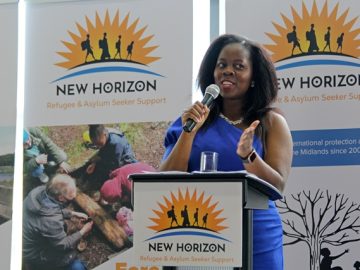
- Tika Mwalughali speaking at the launch of Tales My Mother Told Me, Athlone Library. Photo: Esther Moliné
-
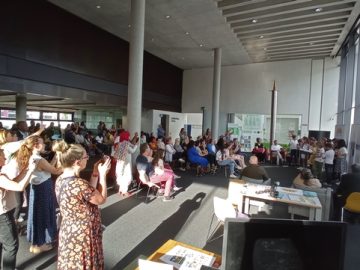

- Launch of Tales My Mother Told Me, Athlone Library. Photo: Esther Moliné
Artistic Outputs
- Book publication: 500 copies of Tales my Granny Told me, copies of which were sent to the Arts Council offices, Direct Provision Volunteer groups and centres across the country. They are also being sent to organisations, both public and private, schools and Universities who work with migrant communities in Ireland.
- Broad radio airplay throughout the summer of 2022 across Athlone Community Radio (with up to 1000 individual listeners daily), on programmes For Arts Sake, Athlone Today, LiveWires, Connect and the Foreign Language Programme, meant a consistent presence of the Residents in their new community.
- The Schools’ Programme initiated with Ranganna 4 & 5 of Scoil na gCeithre Maistrí, which was an astounding success. Over the course of several Resident visits and translation workshops, the pupils translated a poem from Bangla to Gaeilge, which was the crowning glory of Tales my Granny Told me and was recited at the launch by the pupils. The significance of this act, where the future adults of the community engaged creatively and with inclusivity with a member of the new Irish community cannot be overstated. To welcome Fahima from Bangladesh, the students had researched Bangla script and made a number of posters to welcome her into their school.
- The addition of the stories to the National Folklore Collection (NFC).
Outcomes
Tales My Granny Told Me gave rise to community involvement and collaboration between the New Irish community and the existing community, creating an avenue for a fusion of cultures for positive impacts. By sharing their artistic skills, knowledge and authenticity through their stories, lullabies and folklore, the voices of the residents of the Athlone Direct Provision Centre were heard, with a sense of belonging within the community thus created.
This project has created a precedent for further collaborative community-based projects for fostering equity, inclusion and nation building practices. It has created a positive visibility of the work for the integration of refugees and asylum seekers, bringing to the fore the importance of organisations such as Create and New Horizon. It provided rich learning opportunities and outcomes for the students in the Athlone community Irish school and added to the National Folklore collection in UCD. If replicated in Direct Provision centres nationwide in collaboration with their local community (e.g. schools, universities, radio, services, libraries), the TMGTM model has the potential to yield multidimensional benefits for the residents, the local community and for the wider society.